







Where the “under the window” habit comes from
In many countries the radiator under the window is such a habit that we carry it over to heat recovery ventilation. Installers often say: “Put the supply by the window so it blows on the glass and the windows don’t fog up.” Sometimes the supply goes into the ceiling right next to the window, sometimes into the floor under the sill, like a radiator.
It sounds logical. The window is the coldest spot in the room and fresh air will “warm it up”. But is that true for air from heat recovery?
You may have seen it at the airport
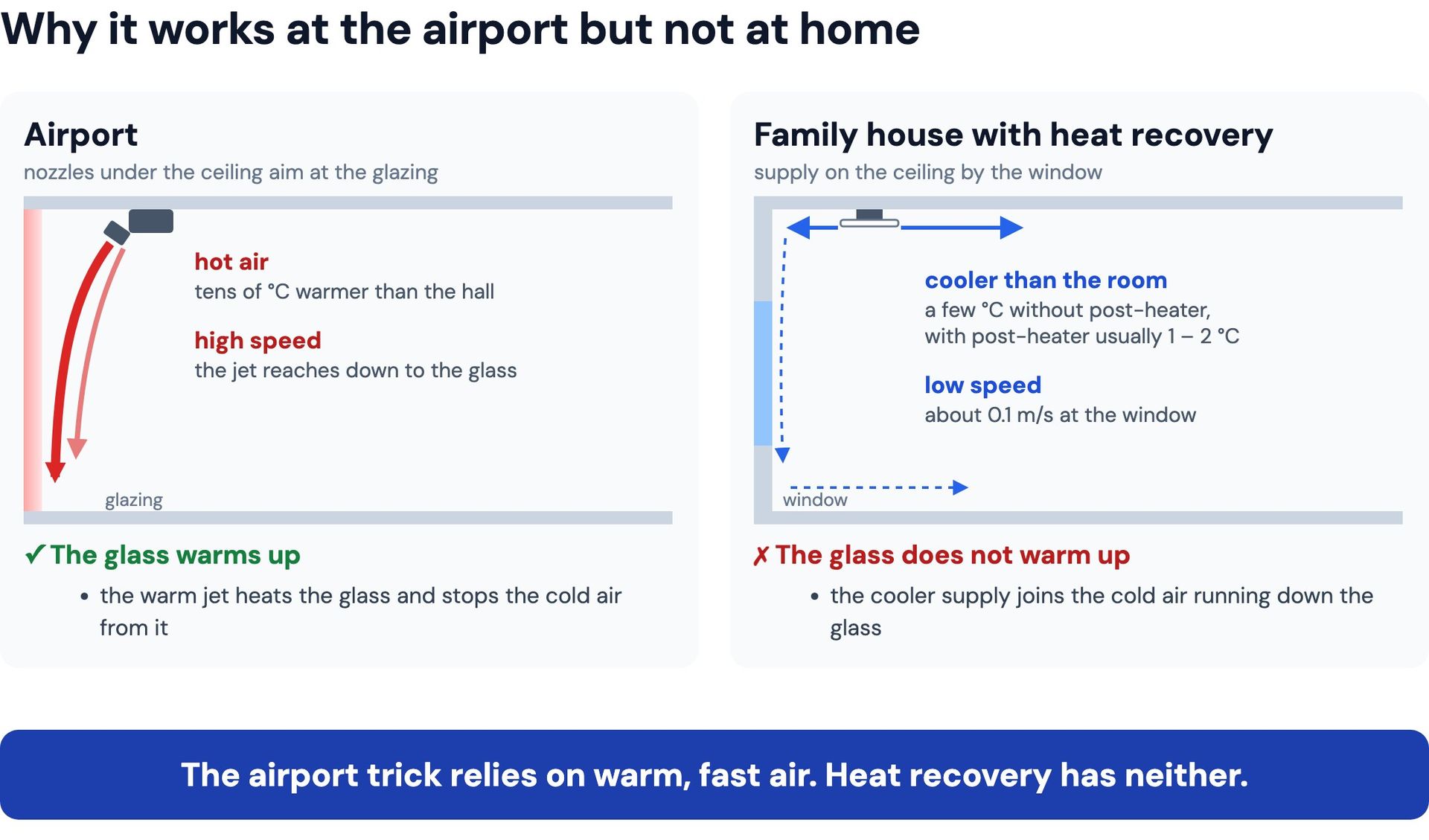
At airports and in halls with glass walls you can see a row of nozzles under the ceiling aimed at the glazing. And yes, it works there. But for two reasons:
- They blow hot air, tens of degrees warmer than the air in the hall. They really do warm the glass.
- They blow at high speed. Warm air wants to rise, so the nozzle has to “push” it all the way down to the glass.
In a family house it is exactly the opposite:
- Air from heat recovery is cooler than the room. Heat recovery returns most of the heat, but not all of it. Without a post-heater, at −7 °C outside and 80 % efficiency the supply air is about 16 °C, i.e. 6 °C below a room at 22 °C. A post-heater does not change this: it is usually set 1 to 2 °C below room temperature.
- The speed is very low. At a typical 30 m³/h the air leaves a disc valve at about 2 m/s, and near the window it is down to about 0.1 m/s.
So the airport trick relies on warm and fast air. Heat recovery has neither.
Why a radiator under the window works and the supply does not
A radiator heats the air to 40–50 °C. Warm air rises, forms a warm curtain at the glass and stops the cold air that runs down the glass to the floor.
Air from heat recovery is cooler than the room, so it does not sink slowly, it drops. From a floor grille it rises only about half a metre, turns and spreads across the floor. From the ceiling next to the window it joins the cold air running down the glass.
What we calculated
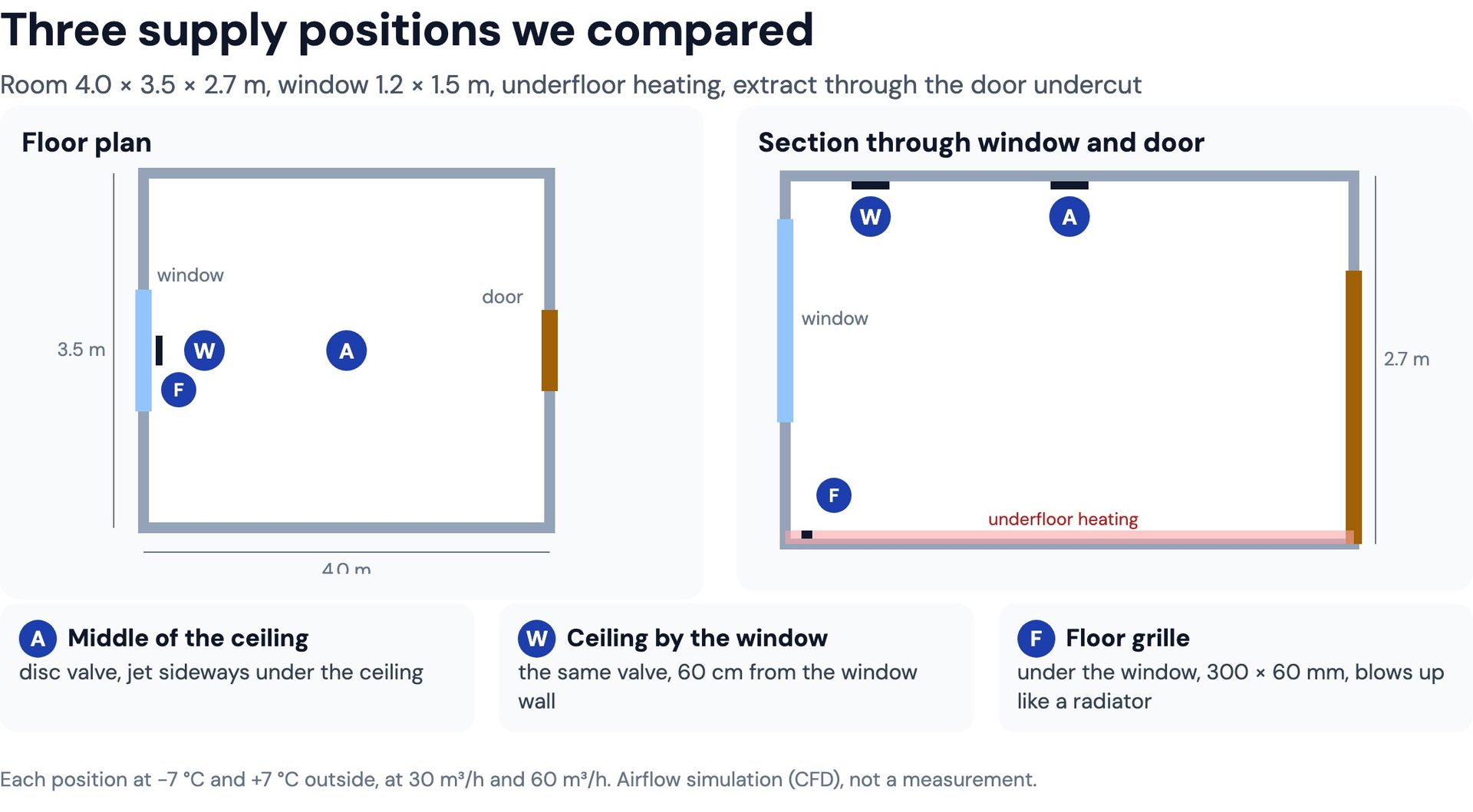
We simulated a room of 4.0 × 3.5 × 2.7 m with a 1.2 × 1.5 m window (double glazing, U = 1.1 W/m²K), a door with an undercut and underfloor heating. The room is at 22 °C, heat recovery efficiency 80 %. We placed the supply in three positions:
- A – middle of the ceiling,
- W – ceiling by the window, 60 cm from the wall,
- F – floor grille under the window, blowing upwards like a radiator.
Each position was calculated at −7 °C and +7 °C outside and at 30 m³/h (normal room ventilation) and 60 m³/h (boost ventilation).
What happened to the glass
This is the main question. The answer is simple: the glass did not get warmer in any position.
| −7 °C, 30 m³/h | A middle | W by window | F grille |
|---|---|---|---|
| average glass temperature | 17.8 °C | 17.9 °C | 17.7 °C |
| coldest spot of the glass | 17.6 °C | 17.7 °C | 17.6 °C |
The differences are within 0.2 °C, i.e. within the accuracy of the calculation. Boost ventilation at 60 m³/h did not help either.
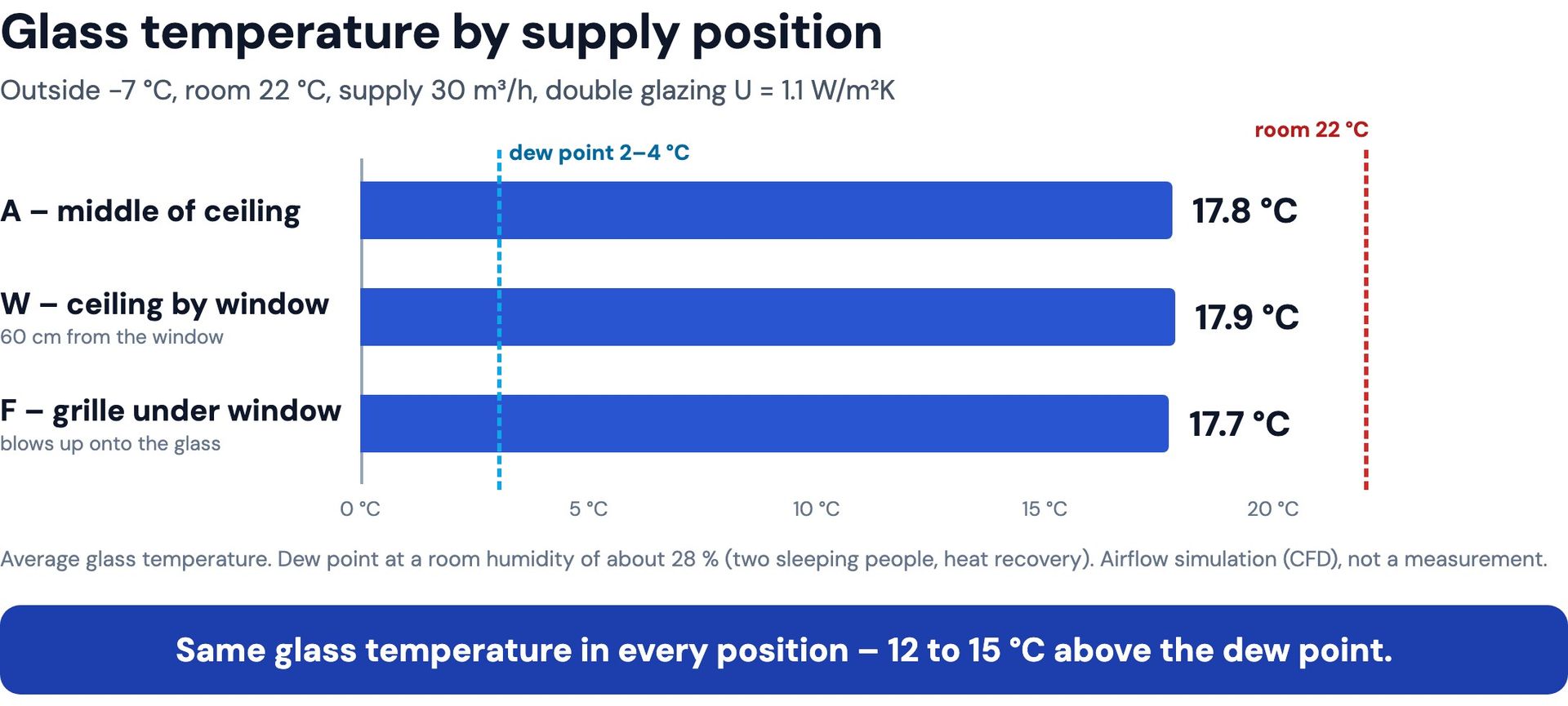
So why don’t the windows fog up? With heat recovery, windows rarely fog up in winter, but for a different reason: heat recovery keeps exchanging the air, so the room is dry. In the simulation the room had about 28 % relative humidity at −7 °C with two sleeping people. The glass was 12 to 15 °C above the dew point. This double glazing would only fog up at a humidity of about 70 %.
If your windows fog up despite heat recovery, the cause is elsewhere: low airflow, old windows, a cold glass edge at the frame, or a unit that is not running. The supply position will not fix it.
What a supply by the window makes worse
At the normal 30 m³/h the differences between the middle of the ceiling and the ceiling by the window were small. With boost ventilation at 60 m³/h, or with a floor grille, they show.
| −7 °C | A middle | W by window | F grille |
|---|---|---|---|
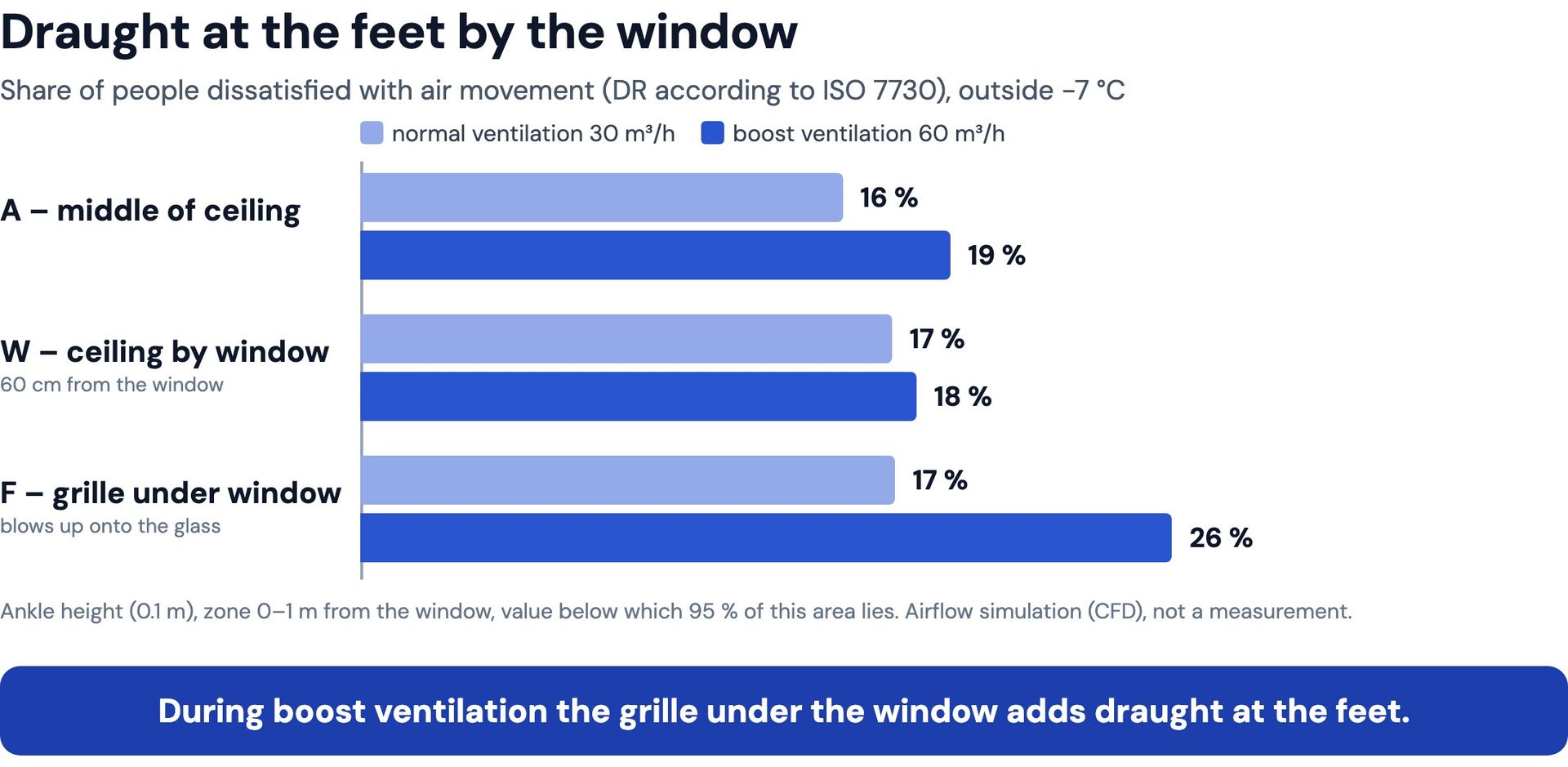
| draught at the feet by the window, 30 / 60 m³/h | 16 / 19 % | 17 / 18 % | 17 / 26 % |
| temperature difference head – feet | 0 K | 0 K | 0.6–0.7 K |
| fresh air reaches people, 30 / 60 m³/h | baseline | 1 / 5 % later | 8 / 6 % later |
| heat lost through the window, 30 / 60 m³/h | baseline | +2 / +8 % | −4 / −5 % |
Draught = predicted percentage of people dissatisfied with air movement (DR according to EN ISO 7730), the value below which 95 % of the area 0–1 m from the window at ankle height lies.
- Ceiling by the window (W): the jet brushes along the window, so more heat is lost through the window, 8 % more at 60 m³/h. Fresh air reaches people a little later because part of it circulates by the window. At +7 °C it was similar: +5 % heat through the window, fresh air 4 % later.
- Floor grille (F): the cold air spreads at the floor. At 60 m³/h the draught at the feet by the window rose from 19 to 26 %. A temperature difference appears between head and feet and fresh air reaches people 6 to 14 % later. Less heat is lost through the window (5 %), but only because cooler air blows on the glass.
- Middle of the ceiling (A): the jet stays at the ceiling, mixes with the room air and reaches people slow and tempered.
The video shows all three positions side by side during boost ventilation. The colour shows the air temperature in a section through the window and the door, the dots are fresh air from the supply over the last 90 seconds.
Outside −7 °C, supply 16.2 °C, 60 m³/h, 5× faster. With the floor grille, notice the cold air that rises only a little and stays at the floor.
How to place the supply in practice
- Do not put the supply by the window to prevent condensation. It will not warm the glass; at best it changes nothing, at worst it increases heat loss or draught.
- On the ceiling, as far from the walls as possible, ideally in the middle of a small room. More in the article Where to place a ceiling diffuser?
- A floor grille under the window is not a radiator. Without heating it blows cooler air at your feet.
- Correct airflow and good windows prevent condensation, not the direction of the supply.
If you are looking for a diffuser with a regulator built into the box, have a look at the plenum box with the Flow 125 diffuser.
The simulation is not artificial intelligence
The results in this article were not created by artificial intelligence. AI cannot calculate airflow; at best it imitates a picture that looks plausible. We used an airflow simulation, technically CFD (computational fluid dynamics).
We divided the room into almost 700 thousand small cells. In each of them the computer solves the physical equations of conservation of mass, momentum and energy: how the air flows, how it mixes, how the walls slow it down and how warmer air rises and cooler air sinks. It does this step by step, every 0.08 seconds.
These are demanding calculations. One case has more than 11 thousand time steps and ran in parallel on 16 processor cores for about two hours. Thanks to this we see the velocity, temperature and humidity at every point of the room at once, which could only be measured with dozens of sensors.
Calculation conditions
| Room | 4.0 × 3.5 × 2.7 m, window 1.2 × 1.5 m (double glazing U = 1.1 W/m²K), door with undercut |
|---|---|
| Heating | underfloor, supplies as much heat as the room loses; room 22 °C |
| Supply | heat recovery 80 %, no post-heater: 16.2 °C at −7 °C, 19.0 °C at +7 °C; 30 and 60 m³/h |
| Supply positions | middle of the ceiling; ceiling by the window, 60 cm from the wall; floor grille 300 × 60 mm under the window |
| Window and wall | real heat transfer to the outside, the glass temperature is calculated, not prescribed |
| Humidity | outside 85 %, two sleeping people in the room (100 g/h) |
| Calculation | transient airflow calculation with buoyancy and turbulence, ~690 thousand cells, time step 0.08 s, 5 min start-up + 10 min averaging |
The calculation does not include people as obstacles, furniture, sun, night setback or the glass edge at the frame. It is a simulation, not a measurement.
Summary
- Blowing supply air on the window does not warm the glass. Air from heat recovery is cooler than the room – a few degrees without a post-heater, usually 1 to 2 °C with one – and slow; the glass temperature did not change in any position.
- The airport is a different case: there hot air is blown at high speed.
- With heat recovery, windows rarely fog up, because the room air is dry (about 28 % at −7 °C).
- At higher airflow, a supply by the window worsens comfort or losses: from the ceiling up to 8 % more heat is lost through the window, from the floor you get a draught at your feet.
- The supply belongs on the ceiling, far from the walls.
Frequently asked questions
Does a heat recovery supply by the window prevent window condensation?
No. Air from heat recovery is cooler than the room and very slow at the window. In the simulation the glass had the same temperature in all three supply positions.
Why do my windows fog up when I have heat recovery?
With normal ventilation the room air is dry in winter and double glazing does not fog up. If it does, look for the cause in low airflow, a unit that is switched off, old windows or a cold glass edge at the frame.
Does this also apply to heat recovery with a post-heater?
Yes. The post-heater is usually set 1 to 2 °C below room temperature, so the supply is still cooler than the room and does not warm the glass.
Can a floor supply under the window work like a radiator?
Not without heating. Cooler air from the grille rises only a little and spreads across the floor. With boost ventilation the simulated draught at the feet by the window rose from 19 to 26 %.
Are these simulations made by artificial intelligence?
No. It is a physical airflow calculation that solves equations for hundreds of thousands of cells of the room. AI cannot do such calculations.